



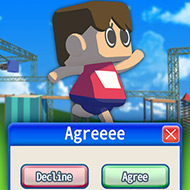
Agreeee
 (1 оценок, среднее: 5.00 из 5)
 Loading...
Popular tags


Similar Games











Popular tags


Description
Agreeee looks like a formality standing between you and the actual game — twelve terms and conditions screens to click through before anything interesting happens — but it plays like the developer already knew exactly how impatient you’d be, and built the entire challenge around that assumption.
| Genre | Puzzle-reflex hybrid |
| Core Mechanic | Navigating deliberately deceptive consent and agreement interfaces |
| Structure | An agreement phase followed by a faster, timed reaction gauntlet |
| In-Fiction Framing | Presented as accepting terms before playing a fictional title, Doki-Doki Action Game |
Twelve Terms Standing Between You and Agreeee
Before the actual game begins, Agreeee makes you accept twelve articles of terms of service tied to a fictional side-scrolling game the setup frames you as being about to play. Those screens are never a mere formality — buttons move mid-hover, labels behave inconsistently, and visual distractions are deliberately introduced to test whether you’re actually reading or just clicking through habit. Rushing this stage is the single most common way new players stall out before Agreeee even properly starts.
The interface mimics familiar software dialogs closely enough to trigger autopilot, and that’s precisely the trap — fonts, spacing, and alignment are all used to guide or mislead your attention, and understanding how the interface communicates its actual state becomes the real early puzzle.
The Timed Action Phase
Once all twelve agreements are successfully processed, Agreeee shifts into a much faster gauntlet of prompts, button layouts, and visual cues that demand quick, accurate responses within tight time limits. Mistakes or hesitation carry real penalties, while a clean run of correct responses builds combos that push your score higher. Patterns learned during the agreement phase continue reappearing here in modified form, which connects both halves of the game into a single, escalating challenge rather than two disconnected systems.
Reading Misdirection Logic
Deeper mastery of Agreeee comes from recognizing the game’s specific tricks — delaying a click slightly to let misleading animations finish, or deliberately triggering a decoy input to force a screen back to a known state. None of this is explained outright; it’s learned entirely through repeated, attentive play.
Why Automation Doesn’t Work Here
The agreement screens are specifically engineered to prevent automated or careless inputs from succeeding, which the game frames narratively as ensuring only genuinely attentive human players can progress. It’s a small but pointed design choice that shapes the entire tone of Agreeee before the reflex-focused half even begins.
What the Concept Says About Digital Habits
Beneath the surface challenge, Agreeee is openly commenting on how casually most people click through real terms and conditions screens without reading them, and several reviewers have praised that framing as clever rather than heavy-handed. Famitsu specifically praised the game’s use of psychologically pointed design tricks, while other outlets have highlighted the unconventional structure as the thing drawing attention to an otherwise small indie release.
- Players drawn to reflex-heavy games gravitate toward the faster action phase once the agreement stage is behind them.
- Streamers and Let’s Players have found the agreement screens particularly effective for reaction content, given how often even attentive viewers miss the same tricks.
- Completionist players replay specifically to memorize every variation the twelve agreement screens can present.
Do the twelve terms and conditions screens change between playthroughs?
Yes — each session presents a new set of traps within the agreement screens, and the action phase can twist its own rules mid-run as well, which keeps repeated playthroughs from becoming pure memorization.
Is Agreeee more about reflexes or attention to detail?
Both, in roughly equal measure — the opening agreement phase rewards careful observation and patience, while the action phase that follows shifts the emphasis toward fast, accurate reflexes built on patterns established earlier.
What is Doki-Doki Action Game inside Agreeee?
It’s the in-fiction title the twelve terms of service screens claim to be gatekeeping access to — a framing device that turns the mundane act of accepting terms into the actual game rather than a barrier standing in front of one.
Agreeee earns its reputation the unusual way, by making twelve boring-looking agreement screens into the most memorable part of the entire experience, and by the time the reflex gauntlet kicks in, the game has already proven its point about how little attention most digital agreements actually get.