







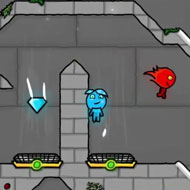
Fireboy and Watergirl 6: Fairy Tales
 (Пока оценок нет)
 Loading...
Popular tags


Similar Games












Popular tags


Description
You drag a small glowing fairy across the screen, watch her drift into a colored lamp, and a lever on the far side of the room clicks into place. Meanwhile Fireboy is standing in a pool of lava he can’t leave yet, waiting on a platform that hasn’t risen. This is the rhythm Fireboy and Watergirl 6: Fairy Tales builds its puzzles around, and it takes a level or two before that rhythm actually clicks.
| Genre | Cooperative puzzle-platformer |
| Levels | 31 total (26 Normal, 5 Dark) |
| Players | 1 or 2 (shared keyboard) |
| Controls | Arrow keys (Fireboy), WASD (Watergirl), mouse (fairies) |
| Core Objects | Red diamonds, blue diamonds, fairies, levers, doors |
How Fairies Change the Formula in Fireboy and Watergirl 6
Every earlier game in the series was about two characters reacting to fixed hazards. Fireboy and Watergirl 6 adds a third layer of control that doesn’t belong to either character directly: the fairies. You click and drag them with the mouse, and each one only activates lamps that match its own color, except for the white fairy, which can trigger any colored lamp or lever it touches. That single exception becomes a genuine strategic resource once you reach the levels where two locked doors need opening within a few seconds of each other.
The game asks you to think about three things moving at once instead of two, and beginners almost always forget the fairy is a separate entity that needs its own path cleared. A fairy can get stuck behind a wall segment or fail to reach a lamp because a platform is in the wrong position, and nothing on screen shouts a warning about it. You just watch Fireboy sit in his puddle of lava a little too long and realize the fairy never made it.
Once you get used to tracking the fairy as a third moving piece, the levels stop feeling like two separate side-scrollers glued together and start feeling like a single puzzle with three moving parts. That shift usually happens somewhere in the first eight or nine levels, right as the game starts introducing levers that only respond to a specific fairy color.
Reading the Butterfly Map
The level select screen is shaped like a butterfly, with chapters unlocking across both wings as you clear earlier stages. It’s a small detail, but it matters for pacing, because it tells you at a glance how much of the game is left and roughly how the difficulty is grouped. Dark levels sit apart from the Normal ones, and they don’t unlock just by finishing the level before them.
Diamonds, Doors, and the Two-Exit Rule in Fireboy and Watergirl 6
Fireboy collects red diamonds and can walk through lava without dying, but a single step into water ends his run. Watergirl collects blue diamonds and can wade through water freely, but lava kills her instantly. Both characters share one rule that neither can break: stepping into the poisoned green water finishes them regardless of element. That third hazard is where a lot of players lose runs late in a level after successfully avoiding lava and water for several minutes straight.
Each level ends with two separate doors, one marked for Fireboy and one for Watergirl, and the level only counts as solved once both characters are standing in their own doorway at the same time. If either character dies, whether from the wrong liquid or a trap triggered by a lever, the round ends immediately for both of them. That shared-fate mechanic is the reason coordination matters more here than raw platforming skill.
Mirrors: scattered through several temple rooms, these reflect a beam of energy toward switches and gates that neither character nor fairy could reach directly, and figuring out the correct angle is often the actual puzzle rather than the jumping itself.
Where Fireboy and Watergirl 6 Gets Genuinely Difficult
The Dark levels are where the game stops being gentle. There are five of them, and they demand near-simultaneous timing between the fairy, Fireboy, and Watergirl in a way the 26 Normal levels never quite ask for. Players on forums tend to describe these as the point where the game “actually starts,” which says something about how much slower the early chapters are by comparison.
A common mistake among newer players is treating the fairy as decoration rather than a required step, dragging her only when a lamp is obviously blocking a path. But several later rooms hide a lever behind a wall that only a specific colored fairy can trigger from an angle you wouldn’t guess without backtracking. Speedrunners, meanwhile, obsess over minimizing fairy travel distance, since every extra second spent dragging her across a room adds directly to clear time on a 31-level run.
Casual duo players tend to split roles by character rather than by task, which works fine until a level demands that whoever controls the mouse also anticipate where the other character needs to stand next.
Frequently Asked Questions
What happens if the white fairy dies or gets stuck in Fireboy and Watergirl 6?
The white fairy can’t die the way Fireboy or Watergirl can, but she can get physically trapped behind scenery if you drag her into a dead end before a platform shifts. If that happens, you’ll need to reset her position by guiding her back out the way she came, since she doesn’t respawn automatically mid-level.
Why does the poisoned green water kill both characters instantly?
Unlike lava and regular water, which only threaten one character each, the green pools are treated as a universal hazard by the level design, meaning neither Fireboy’s fire immunity nor Watergirl’s water immunity applies. It’s the game’s way of forcing careful movement even in sections where players have gotten comfortable ignoring one of the two standard liquids.
How many levels do you need to clear before Dark levels unlock in Fireboy and Watergirl 6?
Dark levels don’t unlock through simple progression; you need to collect enough diamonds across the Normal levels first, since the game gates the five Dark stages behind a diamond total rather than a level count. This pushes completionists to revisit earlier rooms they may have solved sloppily on a first pass.
Fireboy and Watergirl 6: Fairy Tales rewards the kind of player who stops treating the fairy as an afterthought and starts planning her route before Fireboy or Watergirl even move, and once that habit forms, the butterfly-shaped map stops looking so intimidating. The green poisoned water stays the one hazard that punishes carelessness from either side equally, and that shared vulnerability is what makes the two-door ending feel earned rather than routine.