








Particle Life
 (Пока оценок нет)
 Loading...
Popular tags


Similar Games











Popular tags


Description
In Particle Life you start with an empty canvas, a handful of colored dots, and a set of attraction and repulsion sliders that mean nothing to you yet — and that blank-slate starting condition is the entire point, because everything the game becomes is something you build from those three ingredients.
| Genre | Emergent simulation sandbox |
| Core Mechanic | Attraction and repulsion rules between colored particle types |
| Objective | None fixed — players define their own goals through experimentation |
| Session Length | Open-ended, driven entirely by player curiosity |
How Rules Become Behavior in Particle Life
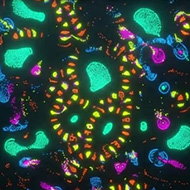
Every particle type in Particle Life follows a simple set of values: how strongly it’s attracted to or repelled by every other type, how fast it moves, and how quickly friction slows it down. None of those numbers look like much in isolation. What makes the game worth returning to is watching how a handful of small adjustments compound into something that looks alive — clusters that pulse, chains that chase each other across the screen, swarms that stabilize into orbit-like patterns nobody explicitly programmed in.
The game never tells you what a “good” configuration looks like. You’re feeling your way toward interesting behavior through trial and error, nudging one slider at a time and watching what breaks or what suddenly clicks.
Finding Life-Like Patterns
The community vocabulary around Particle Life leans heavily on biology terms — players talk about “creatures,” “colonies,” and “predator-prey” dynamics even though nothing in the simulation is explicitly alive. That language sticks because the emergent patterns genuinely resemble ecosystems: one particle type chasing another, stable clusters that hold shape until a rule change destabilizes them entirely.
Beginners tend to make sweeping changes across every slider at once, which almost always collapses a promising pattern into chaos or stillness. Experienced players adjust one relationship at a time and let the simulation run long enough to actually show what changed, since Particle Life’s results aren’t always immediate.
The Hand of God and Manual Nudging
Some versions of Particle Life include a direct-interaction tool, often nicknamed Hand of God by players, that lets you swipe to herd particles or press to draw them toward your cursor. It’s a small addition, but it turns a purely observational sandbox into something you can actually steer mid-simulation, which matters if you’re trying to rescue a pattern that’s about to fall apart.
Why Small Number Changes Matter So Much
What surprises new players most is how disproportionate the outcomes can feel relative to the input. A friction value nudged by a fraction can be the difference between particles drifting apart forever and particles locking into a stable formation that holds for the rest of the session — and that sensitivity is exactly why exploring Particle Life rewards patience over aggressive experimentation.
What players argue about most isn’t a balance issue, since there’s no win condition to balance — it’s how much control the interface actually gives you. Some versions offer precise number entry, while others rely on sliders that several players have criticized as too imprecise for fine-tuning the exact behavior they’re chasing. It’s a fair complaint, and it’s worth knowing before you sit down expecting pixel-perfect control over your particle colony. By the time a stable, faintly organic pattern locks into place on your screen, Particle Life has usually done what no explicit rule set ever could — proven that complexity doesn’t need a designer, just attraction, repulsion, and enough patience to let a simple rule keep running.